

Nutrition is a big topic.
It is complex, but it doesn’t have to be scary or hard.
Let’s make it fun!
To learn more about your personal dietary needs, visit your primary care provider and/or a dietician for guidance.
Refer to the Helpful Resources tab to explore a selection of guidebooks that provide much more detailed information.
It is important to pay attention to what we eat, regardless of dietary pattern. Including animal-based foods does not guarantee getting a full compliment of nutrients. For example: Highly processed and animal-based foods can crowd out fiber because fiber is only in plants.
Leaving animals off the plate doesn’t mean having no fun.
It means inviting peace, abundance, creativity… and fun!

Whole plant foods contain most of the nutrients our bodies need to thrive, but Vitamin B12 must be supplemented on a plant-based/vegan diet.
Even omnivores are commonly B12-deficient, especially in older age.
Notable Nutrients:
Vitamin B12 (cobalamin): must be supplemented in a plant-based diet. Thankfully, supplements are widely available and inexpensive. 50 mcg or 1,000 mcg twice a week, or 2,000 mcg weekly/weekly cyanocobalamin is sufficient for most people. However, it is essential to consult with your primary care provider to monitor your blood levels and receive specific recommendations. Deficiency leads to anemia, nerve damage, or cognitive problems like dementia. Blood tests can check B12 levels directly and monitor other signs of B12 deficiency, such as red blood cell size. Age over 55 is a risk factor for B12 deficiency due to decreased stomach acid, which leads to reduced absorption.
Iodine: Iodine is vital for thyroid function. Too little or too much can cause the thyroid gland to over- or underfunction, leading to serious metabolic problems. One way to incorporate iodine is by using iodized salt. It is also contained in most complete multivitamin supplements. Natural sources of iodine originate in marine life, including seaweed (such as kelp), fish, and ocean water. Dairy products contain iodine, not because it is naturally present in milk; rather, iodine solutions are used to clean cows’ udders and teats before milking, and this iodine is transferred into the milk. Some plant milks are fortified with iodine.
Vitamin D: Most people, meat eaters, and vegetarians alike might benefit from Vitamin D supplementation. The primary mechanism for obtaining Vitamin D is through a reaction that occurs when the sun's rays touch our skin. Thankfully, more people protect their skin from the sun with clothing or sunscreen in modern times, which helps us avoid skin cancer. However, most of us living in the Northeast or with darker skin tones may not be getting enough direct sunlight to produce sufficient Vitamin D. This is essential for building new bone, and deficiency can lead to psychiatric symptoms, such as depression. Some foods are fortified with Vitamin D, such as plant milk. There are two forms of Vitamin D supplements
D2: Ergocalciferol: plant-based and fungal sources: mushrooms (UV-exposed), fortified foods
D3: Cholecalciferol: primarily animal-based: fish oil, lanolin (sheep’s wool), or vegan D3 from lichen
Minerals: inorganic elements that your body needs in small amounts to perform vital physiological functions. Unlike vitamins (which are organic and can be broken down by heat or air), minerals come from the earth and water.
Categories of Dietary Minerals
Macrominerals — needed in larger amounts (>100 mg/day):
Calcium (Ca): bone and teeth formation, muscle contraction, nerve transmission
Phosphorus (P): bone structure, energy metabolism (ATP)
Magnesium (Mg): enzyme activation, muscle and nerve function
Sodium (Na): fluid balance, nerve function
Potassium (K): heart rhythm, muscle contraction
Chloride (Cl): fluid balance, stomach acid (HCl) formation
Sulfur (S): part of amino acids and some vitamins
Trace Minerals (Microminerals) — needed in tiny amounts (<100 mg/day):
Iron (Fe): oxygen transport (hemoglobin)
Zinc (Zn): immune function, wound healing, enzyme activity
Copper (Cu): energy production, connective tissue formation
Manganese (Mn): bone formation, metabolism
Iodine (I): thyroid hormone production
Selenium (Se): antioxidant defense, thyroid function
Fluoride (F): strengthens teeth and bones
Chromium (Cr): enhances insulin action
Molybdenum (Mo): enzyme cofactor in detoxification
Calcium: Leafy greens, such as kale, bok choy, mustard greens, and broccoli, are excellent sources of highly absorbable calcium. Other leafy greens, such as spinach and Swiss chard, also contain high amounts of calcium but also contain oxalates, which bind to the calcium and decrease its absorption. This is one reason why it’s good to consume a variety of different plant foods rather than relying on one or two. Many products are fortified with calcium, such as plant milk and calcium-set tofu. It is helpful to read labels to know which products are fortified. Cow’s milk contains calcium, of course, but it is less absorbable than plant sources. Where do cows get their calcium? From leafy greens! Why not go directly to the source and get fiber, minerals, and antioxidants as added benefits?
Protein: The protein category on the plate represents the most significant change when transitioning to a more plant-based diet. Many people refer to different types of animal meats as “proteins.” Thankfully, all plant foods contain complete proteins. The different essential amino acids (building blocks of protein) are present in varying amounts in different plants, so eat a variety of whole plant foods, including beans, greens, whole grains, nuts, and seeds. Remember that even if you eat more protein, you will not increase muscle mass unless you work your muscles through exercise. Once the body has met its needs for protein for the day, extra protein is converted to carbohydrate or STORED AS FAT.
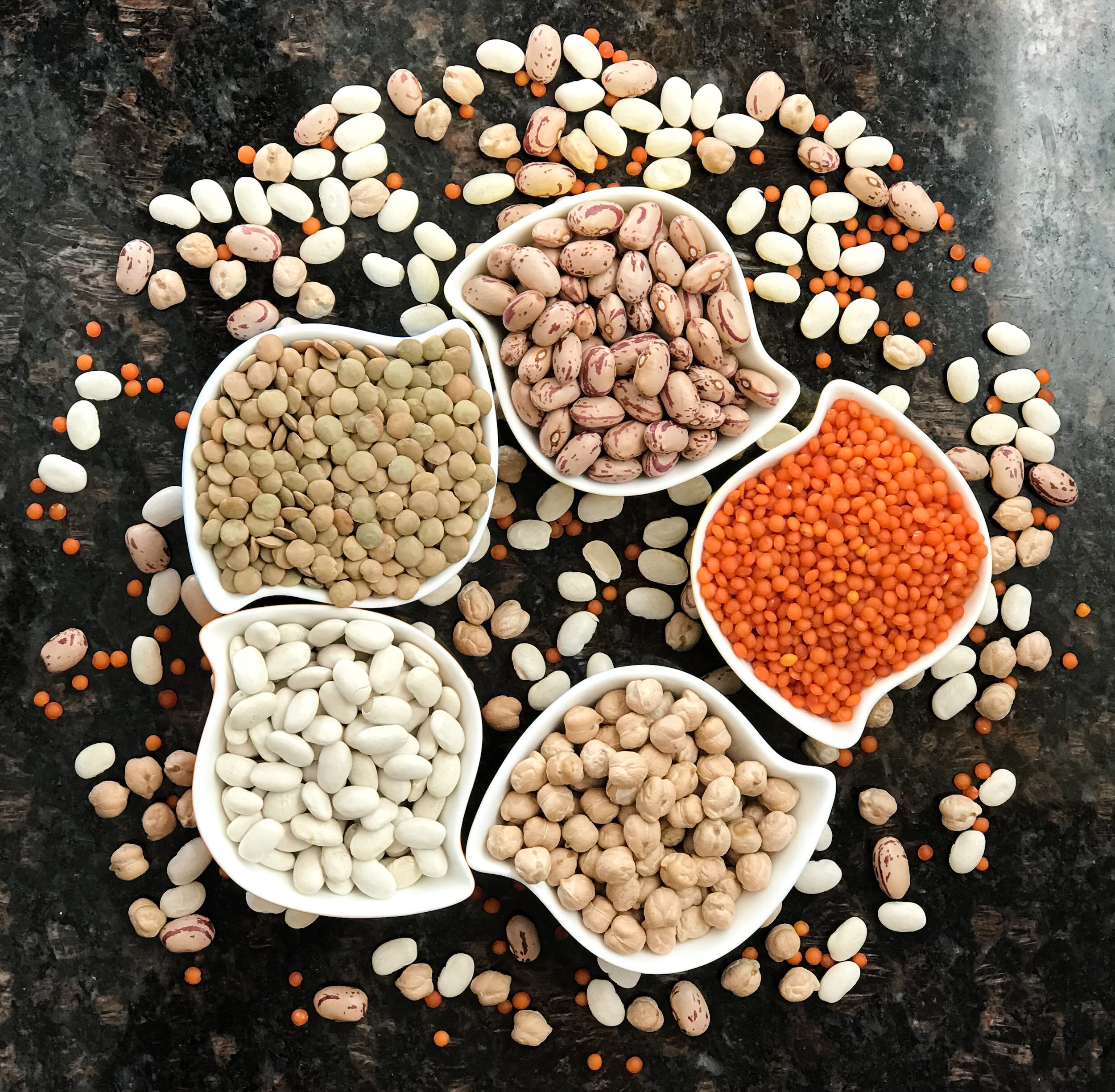
BEANS are a great source of pretty much everything (protein, fiber, minerals, carbs, phytonutrients…). Additionally, whole grains are a rich source of plant-based protein, fiber, and complex carbohydrates. Soy-based foods, such as edamame, tofu, and tempeh, are high in protein and fiber.
Replace dairy milk with soy milk for comparable protein and calcium (if it’s fortified) and even some fiber as an added benefit! Soy products, including tofu, actually reduce breast cancer risk and do NOT cause feminization in men or women. They do contain phytoestrogens, but the effect is not to stimulate our receptors in the same way animal estrogen does; rather, the effects are protective.
Fiber: Plants have all the fiber!! Zero Americans are deficient in protein, but most are deficient in fiber. Dietary fiber helps with all sorts of health goals: weight loss/maintenance, improved gut microbiota diversity, improved bowel movement regularity, and increased release of GLP-1 (yes, like the injectable weight loss medication… we make that automatically when we eat fiber). Animal foods (meat, dairy, eggs) contain ZERO fiber.
Fiber feeds the gut microbiota, which produce vitamins and other substances that benefit our bodies. Products of gut microbes include short-chain fatty acids, such as butyrate, acetate, and propionate. Higher levels of SCFAs are associated with health benefits, including a decreased risk of colon cancer, improved blood sugar control, and enhanced gut barrier function.
Omega-3 fatty acids: Long-chain Omega-3 fatty acids (such as DHA and EPA) are beneficial for cognition and mental health, among other health benefits. These are most commonly found in fatty fish, such as wild-caught salmon, but where do the fish get them? Answer: seaweed! Vegan Omega-3 supplements are sourced from seaweed. Eating Omega-3 FAs provides the building blocks for the body to make the long-chain varieties.
Flax seeds- buy whole and grind at home before eating using a blender, food processor, or coffee/spice grinder- (also decrease breast cancer risk due to their high lignin content), walnuts, chia seeds, and hemp seeds are a few examples of foods that have a higher density of Omega-3 fatty acids. Omega-6 Fatty acids are also part of a complete nutrition from food, but they tend to be more prevalent in a Western diet. When the ratio of 6’s to 3’s is out of balance, which typically means too many 6’s in the USA, our bodies are less efficient at converting short chains into long chains. There is some evidence to suggest that Omega-3 supplements may be beneficial. Those sourced from algae oil rather than fish oil are equally beneficial.
Eating Plants = Abundance
Other Important Nutrients:
Phytonutrients:
Also called phytochemicals, these are natural compounds found in plants that contribute to their color, flavor, and disease resistance. They support health by reducing inflammation, neutralizing free radicals, and promoting cellular repair, which helps prevent cancer, heart disease, and cognitive decline:
Carotenoids
Examples: Beta-carotene, Lycopene, Lutein, Zeaxanthin, Alpha-carotene
Found in: Carrots, tomatoes, sweet potatoes, spinach, kale
Benefits: Antioxidant activity; support eye and immune health
Flavonoids
Subgroups include:
Flavonols (quercetin, kaempferol — onions, kale, apples)
Flavanones (hesperidin, naringenin — citrus fruits)
Flavan-3-ols (catechins — tea, cocoa, berries)
Anthocyanins (cyanidin, malvidin — berries, red cabbage, grapes)
Isoflavones (genistein, daidzein — soybeans)
Benefits: Anti-inflammatory, antioxidant, heart and brain protection
Glucosinolates
Found in: Broccoli, cabbage, kale, Brussels sprouts
Benefits: Support detoxification and cancer protection
Phenolic Acids
Examples: Caffeic acid, Ferulic acid, Gallic acid
Found in: Coffee, whole grains, berries, nuts
Benefits: Antioxidant and anti-inflammatory
Phytoestrogens
Examples: Lignans (flaxseed, sesame) and Isoflavones (soy)
Benefits: Hormone balance, bone and heart health
Saponins
Found in: Beans, legumes, oats, spinach
Benefits: Cholesterol-lowering, immune support
Terpenes and Terpenoids
Examples: Limonene, Menthol, Squalene
Found in: Citrus peel, mint, herbs, olives
Benefits: Anti-inflammatory, antimicrobial
Alkaloids
Examples: Caffeine, Theobromine, Capsaicin
Found in: Coffee, cocoa, peppers
Benefits: Stimulate metabolism, may support pain modulation
Organosulfur Compounds
Found in: Garlic, onions, leeks
Benefits: Heart health, immune support, cancer protection
Resveratrol and Stilbenes
Found in: Grapes, peanuts, red wine, berries
Benefits: Heart and brain protection, longevity support

For your health and for a healthier planet.
One decision you can make multiple times per day that will improve your overall health and decrease your contribution to climate change is to eat more plants and fewer animals. Not only is eating plant-based food easy once you get the hang of it, but you can also feel good about doing less harm to animals and our home, planet Earth.

Books that I have found especially helpful and practical:
Nourish: The Definitive Plant-Based Nutrition Guide for Families by Reshma Shah, MD, MPH, and Brenda Davis, RD
Vegan for Life, Second Edition by Jack Norris, RD, and Virginia Messina, MPH, RD
Eating Plant-Based: Scientific Answers to Your Nutrition Questions by Dr. Shireen Kassam and Dr. Zahra Kassam
A Parent’s Guide to Intuitive Eating: How to Raise Kids Who Love to Eat Healthy by Dr. Yami Cazorla-Lancaster, DO, MPH, MS, FAAP
There are so many others!!! I chose this short list of easy-to-access books because they offer practical answers and actionable, evidence-based guidance. Refer to the Helpful Resources page for more books.